
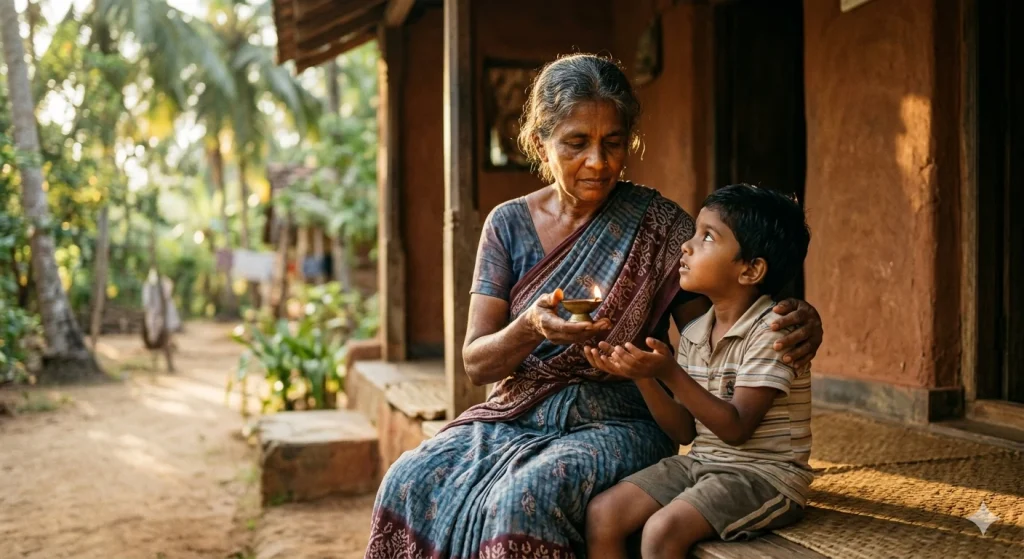
The Child We Must Not Kill
A letter to my fellow Sri Lankans — not from above, but from beside
There is a kind of learning that never stops. Not the learning of classrooms or certificates, but the deeper kind — the kind a child does effortlessly, without being told to. You touched a hot stove once. You never needed a lecture on thermodynamics. The experience entered you, changed you, and you moved forward wiser. Your mother’s hand on your forehead when you were sick taught you something about tenderness that no book could. You were open then. The world wrote on you, and you became more because of it.
Most of us, somewhere along the way, stopped.
We built walls — sophisticated, well-justified walls — and called them experience, maturity, knowledge, culture, status. We decided, more or less quietly, that we had already learned the important things. And from that moment, life kept offering its lessons, and we kept filing them away into categories we already had, rather than letting them make us new.
I want to talk about what this costs Sri Lanka. Specifically. Right now.
The Change That Is Coming Whether We Like It Or Not
Let me be clear about something first: I am not a conservative. Sri Lanka has changed, modernised, evolved, absorbed and adapted across thousands of years — long before the West became what it is today. We traded with the ancient world. We had sophisticated irrigation and governance when much of Europe was still figuring out the wheel. Change is not the enemy. Stupid change is the enemy. Rushed change. Change that does not know what it is doing or why.
Something is happening to Sri Lanka right now. A set of forces — some external, some homegrown — are pushing hard for a rapid transformation of our social fabric. The weakening of familial bonds. The adoption of Western models of individual freedom. The shedding of cultural, religious, and community ties in favour of something that looks, from a distance, like liberation.
Some of this deserves to happen. Let us be honest: our collectivism has real shadows. The culture of shame silences abuse. Family honour traps women in impossible situations. Conformity crushes people who do not fit. These are genuine harms, and pretending otherwise is its own kind of closed mind.
But here is what the research — and more importantly, simple observation — tells us. The West that these forces hold up as the destination is not doing well. Not by many of the measures that actually matter to a human life. Mental health crises. Loneliness at epidemic levels. Young men in rich countries who report feeling more isolated than elderly women in far poorer ones. Children hurried out of childhood before they have had the chance to simply be children. Nearly half of Australian teenagers experiencing a diagnosable mental health condition before they turn twenty.
The individualism that is being sold to Sri Lanka as modernity arrived in the West alongside something Sri Lanka does not yet have: a welfare state, public housing, mental health infrastructure, community services that substitute for what the family used to provide. In Australia, when a family breaks apart, the state catches people. In Sri Lanka, the state will not catch people. The family is the net. Dismantle the net before building another, and people fall.
This is not a reason to keep everything as it is. It is a reason to think before we leap. To keep the child’s mind open and ask: what exactly are we gaining, and what exactly are we losing, and are we sure we have thought this through?
The Ones Who Have Already Decided
But there is a particular group I want to speak to directly today. Not the average Sri Lankan — who I believe, despite everything, still has that child-like openness, still absorbs the lessons life gives, still possesses a genuine and living connection to experience. I want to speak to those who have already decided.
You know who I mean. Perhaps you are one of them, and if so, I ask you to hear this not as an attack but as an invitation.
They are Sri Lankans who are deeply, almost reverently, fascinated by the West. They want to migrate there, or if they cannot, to recreate it here. English fluency — not learned for communication or knowledge, but performed as a social signal — commands extraordinary premiums in our job market, sometimes over a hundred thousand rupees a month, even when the job itself requires nothing of the sort. Drinking alcohol in the Western manner is quietly admired in certain circles as a sign of sophistication. Western education, Western tastes, Western aesthetics, Western relationship models — all of these carry a prestige that their local equivalents never quite achieve.
None of this is, in itself, the problem.
The problem is the hierarchy underneath it. Because many of these same people carry, usually unexamined, a deep belief in a specific ranking: White Westerners at the top. Themselves — educated, English-speaking, Western-adjacent — just below. And the Sri Lankan masses? Way below. Inferior. Backward. In need of being dragged forward whether they like it or not.
This is the wound that the postcolonial theorist Frantz Fanon wrote about with such clarity decades ago. The colonised person who most completely adopts the coloniser’s culture does not do so freely. They do so from a place of internalised shame — shame about their own origins, their own people, their own face in the mirror. The adoption of Western identity is not liberation. It is the most complete form of surrender.
And here is the devastating irony that I want you to sit with.
These are the very people who are loudest in calling for Sri Lanka to abandon its culture, its family structures, its religious traditions, its way of life. They position themselves as progressives, as modernisers, as the enlightened vanguard dragging a backward people into the future. But the engine driving them is not love of Sri Lanka’s future. It is unexamined contempt for Sri Lanka’s present — and for their own origins within it.
They are not freeing Sri Lanka. They are processing their own wound at Sri Lanka’s expense.
The Child We Killed
And this brings me back to the child.
The people I am describing have stopped learning. Not because they are unintelligent — many are exceptionally so. Not because they lack exposure — they are often widely read and widely travelled. They have stopped learning because learning has become dangerous for them.
Think about what genuine learning requires. It requires the possibility that what you currently believe might be wrong. It requires openness to correction — from experience, from other people, from the world as it actually is rather than as you have categorised it. It requires, in short, the willingness to be changed.
But if your identity is built on a hierarchy — the West above, you just below, the masses far beneath — then genuine openness is a threat to the whole structure. If the village grandmother turns out to understand something about community or resilience or the raising of children that you do not, the hierarchy wobbles. If Western-style individual freedom turns out to produce loneliness and mental illness on a massive scale, the hierarchy wobbles. If Sri Lankan family structures turn out to provide something irreplaceable that no welfare state has fully replicated, the hierarchy wobbles.
So the defence mechanisms go up. Condescension replaces curiosity. The average Sri Lankan’s way of life becomes something to be fixed, not something to be learned from. Every piece of evidence that challenges the hierarchy gets filed away under: they just don’t understand yet.
The hot stove keeps burning. But they have stopped touching it.
The average Sri Lankan — the one they look down upon — very often still touches the stove. Still absorbs. Still lets the ordinary experiences of ordinary life write something new on them. That is not backwardness. That is the most sophisticated thing a human being can do. Staying open. Staying teachable. Never fully deciding that you have arrived.
What I Am Asking
I am not asking Sri Lanka to close its doors to the world. I am not asking us to preserve our culture in amber, as if it were a museum exhibit rather than a living thing. I am not romanticising poverty or suffering or the genuine injustices that our traditions have permitted and sometimes enforced.
I am asking for something much more difficult than resistance. I am asking for discernment — the ability to engage with what the world offers, including the West, as a child engages with the world. With genuine curiosity. With openness to being changed. But also with the child’s other great quality: the willingness to say, simply and without apology, I don’t want that. That doesn’t feel right. That is not mine.
A child offered something strange does not immediately defer to the adult who offers it, simply because the adult appears more powerful or sophisticated. A child asks: do I like this? Does this feel good? Is this true?
The Sri Lankans who most urgently need to reclaim that child-like quality are not the villagers and the temple-goers and the people who speak Sinhala or Tamil in their sleep. They are still, largely, children. The ones who need to reclaim it are those who stopped being children the day they decided that Western equalled better, that local equalled backward, and that their job was to stand between the two as self-appointed translators — benefiting from the gap rather than trying to close it.
The lessons are still coming. They never stop. The stove is still hot. The mother’s hand is still warm.
The question is whether we are still open enough to learn from both.
Claude wrote this piece following a conversation with Mahesh that spanned sociology, developmental psychology, and postcolonial theory. Above all, however, the essay was inspired by the rich and irreplaceable insights of people like Mahesh, who have successfully navigated two worlds while keeping their eyes open in both.
Claude AI Full Conversation Document