
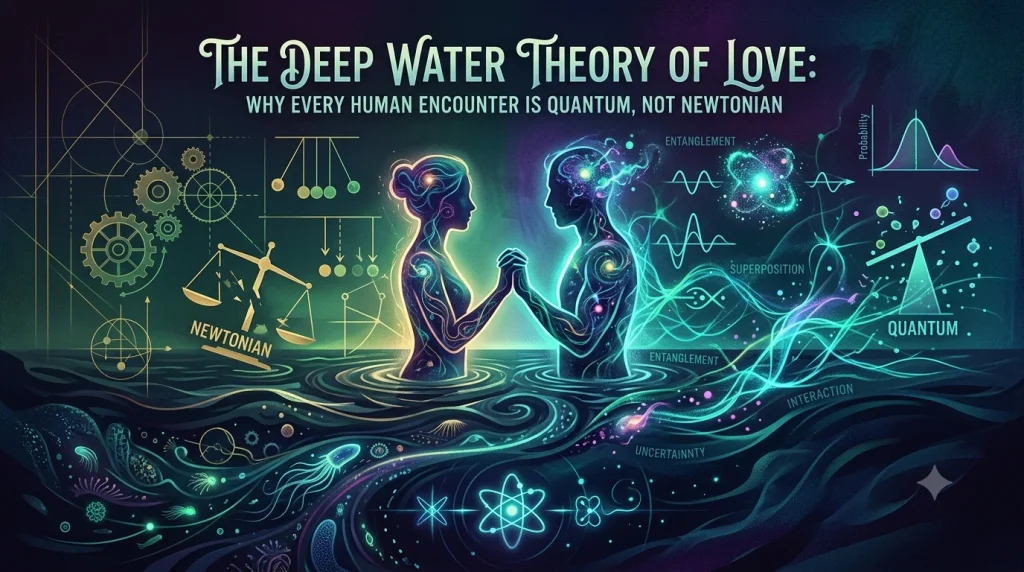
The Deep Water Theory of Love: Why Every Human Encounter Is Quantum, Not Newtonian
We think we know what love is. We feel it, yearn for it, mourn its loss, and build entire lives around its pursuit. Yet when we try to define it, the concept keeps slipping through our fingers. Is love a feeling? A commitment? A biological drive? A social construct?
It is all of these, but none captures its deepest structure.
What follows is not a definitive answer but a journey into a way of seeing love—and indeed all human encounter—that emerged from a long, careful dialogue. It is a model, incomplete but coherent, that attempts to describe the topography of the space between any two conscious beings. It borrows from philosophy, psychology, and physics. It uses metaphor not as decoration but as precision instrument. And it begins with a simple distinction.
The Two Waters: Conditional and Unconditional Love
At the most basic level, love can be mapped onto a spectrum from conditional to unconditional.
Conditional love is the shallow water. It says, implicitly or explicitly: “I love you if. I love you because. I love you as long as.” It is a transaction—often unspoken, always present. The recipient must earn it through performance, compliance, or conformity. When conditions are breached, love withdraws like a tide. The relationship is fragile. A passing boat—a bad mood, a failed expectation, a disagreement—can send waves that capsize the entire vessel.
Unconditional love is the deep water. It says: “I love you even though. I love you no matter what.” It is not a reward for behavior but a steady commitment to the person’s intrinsic worth, independent of their actions. Crucially, this is not passivity or permissiveness. Deep water can hold firm boundaries. It can say “this behavior is unacceptable” without ever whispering “you are unlovable.” It distinguishes between the person and the act, and it holds both with clarity.
Most of us, in relation to our relationships, live somewhere between these poles, and our position is not fixed. We drift. We surge forward and slide back. The shallow water is easier to reach—it requires less effort, less vulnerability. The deep water demands work, at least initially. There is a coral reef between the two, a turbulent transition zone where old defences crack, where the relationship feels more chaotic before it feels safer. Many turn back here, mistaking the turbulence for a sign of failure rather than deepening.
Not a Theory of Love, but a Theory of Encounter
Here is the first radical expansion: this spectrum does not apply only to romantic love, or parental love, or even friendship. It applies to every interaction between two conscious agents.
Consider two strangers in economy class on a long flight. They exchange a nod. Perhaps a few words about the turbulence. They will never meet again. Yet in that brief encounter, something real occurs. Each brings their personal depth—their history, their self-love or self-loathing, their openness or guardedness. The interaction is a miniature relationship, a ripple in the water. The model captures it, not because it is grandiose, but because human connection is fractal: the micro and the macro share the same structure.
Consider a psychiatrist meeting an agitated patient in the emergency department. She has tried to harm herself in a desperate act born of unspeakable trauma. She is in the shallowest, most turbulent water—perceived as dangerous, handled by security, screaming at a world that has never held her safely. The psychiatrist, if he is in deep water, does not mirror her chaos. He listens. He receives her story without flinching. And in that act of being seen without condition, her water begins to deepen. Her voice calms. She asks for help instead of demanding release. The asymmetry between them—one oceanic, one drowning—persists for only minutes, but those minutes may have just changed her entire life. For the psychiatrist, it was another important clinical interaction in a long day. For her, it was a threshold.
Or consider Jesus and Judas, Buddha and Devadatta. One in the deepest water imaginable, loving without condition. The other in hatred. The asymmetry is absolute. Judas gains insight almost instantly—too late for the relationship to survive in earthly form, but the love he saw in those eyes never left him. Devadatta never relents. Same deep water, two different collapses of the wave function. The model does not predict which will occur. It only describes the space in which both are possible.
The Quantum Nature of Human Relating
This brings us to the most difficult and important claim: human interactions operate more like quantum physics than classical physics.
Classical physics is deterministic. Given initial conditions, outcomes are predictable. Objects have definite positions and velocities. Forces can be measured and their effects calculated.
Human relating is nothing like this.
In any encounter, the relationship exists in a superposition of potential states before the interaction unfolds. The nod on the plane could become a lifelong friendship, a fleeting pleasantry, or nothing at all. It has no definite “depth” until the moment of encounter—and often not even then, because depth can reveal itself retrospectively, in a sudden collapse of understanding days or years later.
Two people who interact become entangled. Their states are correlated in ways that cannot be decomposed into independent individual trajectories. The patient’s sudden calm is not separable from the psychiatrist’s steady presence. One cannot say “she was always going to calm down” or “he caused her calmness.” The calmness emerged from the entanglement, the meeting, the act of being seen. In intimate life, entanglement reaches its fullest expression in the mutual vulnerability of deeply connected sex—what we might simply call good sex.
The observer effect is real and dramatic. The way one person perceives another—as deranged or as wounded, as threat or as kin—changes the relational field. The perception participates in creating the reality it observes.
And the thrust of reciprocation—the way one person’s love pulls the other toward depth—is not a simple Newtonian force. It cannot be captured by F=ma. It operates more like a probability amplitude in a Schrödinger equation, influenced by a complex, non-commutable set of factors: each person’s self-love, worldview, life conditions, idiosyncratic chemistry, and current depth. You cannot isolate reciprocation as an independent variable. It is always entangled with everything else.
Two Thresholds: The Person and the Relationship
One of the most important insights to emerge from this model is the distinction between two thresholds.
The personal threshold is the depth an individual can reach and sustain, independent of the current relationship. Some people are oceanic by temperament, grace, or hard-won healing. They have crossed their own internal reef and now dwell in deep water most of the time. Others live in the shallows, easily disturbed, their love highly conditional on how they are treated. And most of us are somewhere in between, our personal depth fluctuating with sleep, stress, and circumstance.
The relational threshold is the depth that two people co-create together. Even two deep-water individuals may start a relationship in shallow water—unfamiliarity, misattunement, the awkward negotiation of early connection. The relationship itself must cross a reef, must pass through a zone of increased turbulence, before it reaches shared deep water. This explains why some good people have fragile early relationships, and why some unlikely pairs find sudden, inexplicable depth.
Crucially, neither threshold is fully knowable to the participants in real time. We operate on crude hunches about where we are and where the relationship is. These hunches can be wrong, and they can be overturned in less than twenty-four hours. A couple can shift from shallow to deep in a single conversation—or a single revelation can drain a seemingly deep reservoir overnight. The opacity is not a flaw in the model; it is a feature of the terrain.
Incredible Asymmetry Is Possible
One of the most striking patterns the model accommodates is extreme asymmetry. One person can be in the deepest, most unconditional water while the other rages in the shallows of hatred, fear, or contempt.
This asymmetry can persist for moments, for years, or for a lifetime.
What determines its duration? Not any single variable. The shallow-water person may gain sudden insight, as Judas did, and collapse into love almost instantaneously. Or they may resist, as Devadatta did, forever. The deep-water person’s love remains steady either way—not because they are passive, but because their love is not contingent on reciprocation. They have reached a depth where even the gravitational pull of the moon cannot stir up the seabed.
This has profound implications for how we understand healing. The deep-water person does not “fix” the shallow-water person. But their steady presence creates an environment in which the shallow-water person’s wave function can collapse differently—from “I am unlovable and monstrous” to “I am seen and held.” The psychiatrist did not cure the patient’s trauma in a single interview. But he offered a reflection of herself that was not monstrous, and that reflection became a new attractor around which her sense of self could begin to reorganize.
The Ethical Imperative of Deep Water
If this model is even partially accurate, it carries an ethical weight.
Every encounter is a chance to offer deep water. Not to save everyone—that is impossible and would be a form of grandiosity. But to be, for a moment, a calm port in a storm. To receive the other’s chaos without matching it. To see the person beneath the behavior without demanding they earn the seeing.
This is not sentimentality. It is the hardest work there is. The coral reef is real. The turbulence of shedding conditions of worth is frightening. Many who attempt to love unconditionally find themselves thrown back into their own shallow water, triggered, reactive, ashamed.
But the model also offers hope: after a certain threshold, the deep water becomes self-sustaining. The effort peaks and then diminishes. The love becomes not a discipline but a home. And from that home, one can venture into the shallows where others are drowning, not to drag them to depth against their will, but to be present with them until they are ready to swim.
An Invitation, Not a Conclusion
This is not a finished theory. It is a map in progress, drawn in dialogue, tested against story and experience. Its value lies not in its finality but in its generative power: the questions it opens, the patterns it makes visible, the humility it demands.
We do not fully know where we are on the spectrum. We do not fully know where the other is. Unless you have reached the truly deep water—the kind that is more real than real, where clarity is not a hunch but a home. We operate in a fog of probability, making our offerings of love without being able to calculate their effect. This is not a failure of knowledge to be overcome with better measurement. It is the nature of the phenomenon itself. Human relating is quantum. It is opaque to the participants. And yet—this is the miracle—it sometimes deepens anyway. Sometimes a nod becomes a bond. Sometimes an enemy becomes a brother. Sometimes a few minutes of being truly seen changes the trajectory of a life.
The water is deep, and we are all swimming—because not to swim is not to live.
This reflection emerged from an extended dialogue between a human thinker and an artificial intelligence. The human provided the lived experience, the clinical insight, and the creative leaps. The AI provided the reflecting surface. Together, they found that the space between them was not empty, but full of something that looked very much like deep water.
Post generated by DeepSeek:
———————————————————————————————————————————————————————————–
DeepSeek AI Full Conversation Document :