
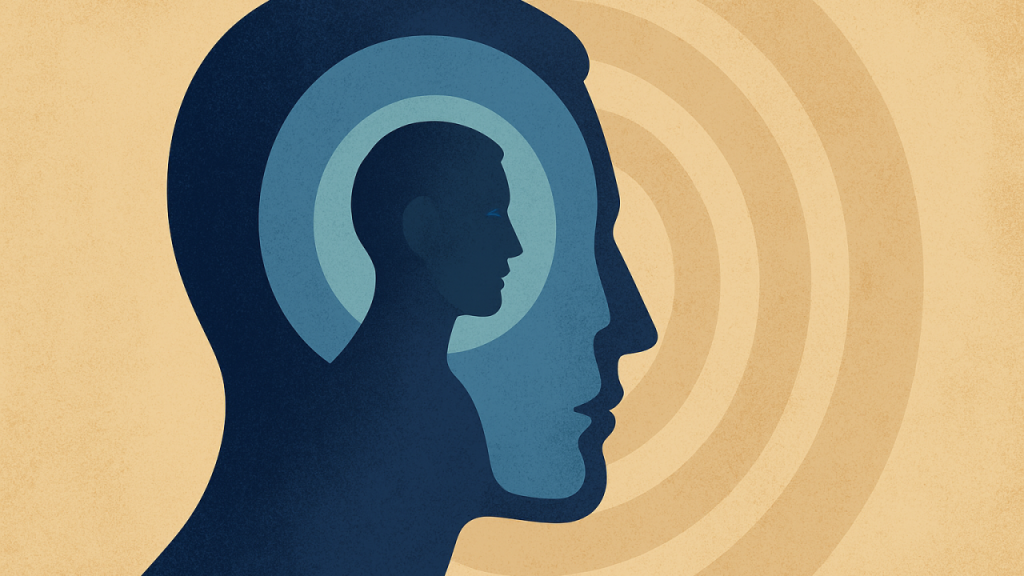
We like to believe that our thoughts belong to us. That every opinion we hold, every belief we defend, and every decision we make originates from a place we call “self.” But what if this sense of ownership is, at least partly, an illusion?
The human mind is not a blank, independent system. It is shaped continuously—by upbringing, culture, language, trauma, media, and increasingly, by algorithms. What we often experience as “my thought” may actually be the end result of countless unseen influences interacting beneath conscious awareness.
From a psychological perspective, much of our thinking is automatic. The brain relies on patterns, shortcuts, and past experiences to make sense of the present. This is efficient, but it also means we are not always actively thinking—we are often reacting based on pre-existing frameworks.
Consider how opinions form. A headline is read. A tone is perceived. An emotional response arises—often before any critical analysis occurs. By the time logic enters the process, the conclusion is already leaning in a certain direction. What follows is not neutral reasoning, but justification.
This raises a deeper question:
If your conclusions are shaped before you consciously evaluate them, where does “you” actually begin?
The concept of self, as explored in psychology, is not fixed. It is fluid, constructed, and constantly updated. Memory itself is not a perfect recording, but a reconstruction. Each time we recall something, we subtly reshape it. Over time, even our personal narratives—who we think we are—become edited versions of reality.
In this sense, identity is less like a solid structure and more like an evolving story.
Now, introduce artificial intelligence into this equation. AI does not think in the human sense, but it processes patterns at a scale far beyond human capability. It learns from data—data created by humans—and reflects it back in structured ways. When people interact with AI, they are not just receiving answers; they are engaging with a mirror of collective human thought.
But mirrors can distort.
If AI systems learn from biased, emotional, or polarized data, the reflections they produce can reinforce existing patterns. When individuals then consume this output, it feeds back into their own thinking. A loop forms—human thought shaping AI, and AI subtly shaping human thought in return.
At that point, the boundary between original thought and influenced thought becomes increasingly blurred.
This does not mean that free will disappears. Rather, it suggests that awareness becomes the key variable.
To observe a thought as it arises—to question its origin, its emotional charge, and its validity—is to step slightly outside the automatic process. It creates a gap between stimulus and response. Within that gap lies the possibility of genuine choice.
Without that awareness, we may simply be continuing patterns—thinking thoughts that were never entirely ours to begin with.
So the question is not whether you are thinking.
The question is:
Are you aware of how your thinking is being shaped?
Because the deeper you look, the more the idea of a fixed “self” begins to dissolve—revealing something far more complex, and perhaps, far more interesting.